
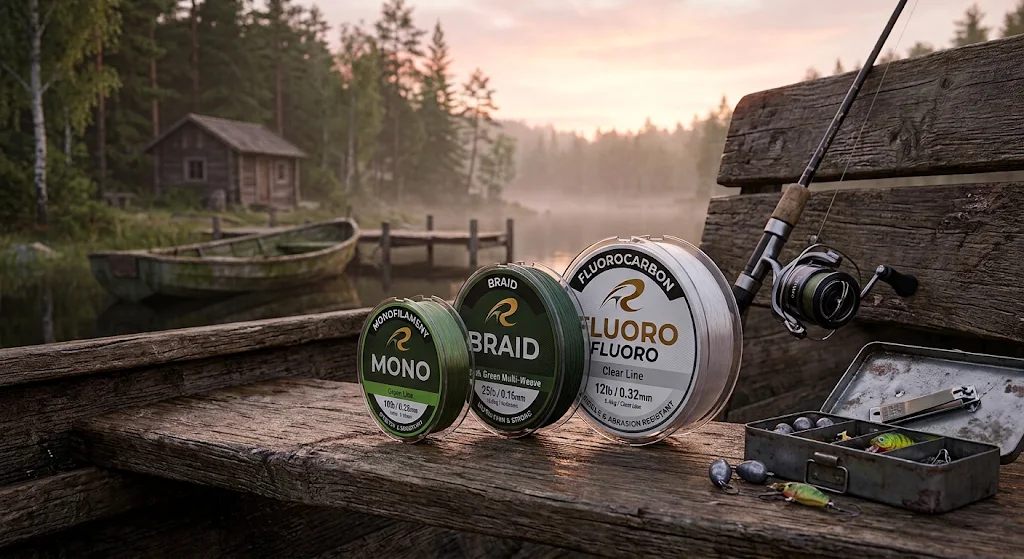
Your fishing line is the only physical connection between you and the fish. You can own the finest rod and reel on the bank, yet the wrong mainline or hooklength can ruin your presentation, reduce bite detection, or snap under pressure.
Understanding the debate around monofilament vs braid vs fluorocarbon is essential for every UK angler. Each material behaves differently in the water, offering distinct advantages depending on whether you are ledgering for carp, trotting a stick float on a river, or casting lures for pike and perch.
Understanding the Three Main Types of Fishing Line
Before deciding which spool to load onto your reel, it helps to understand how each line is manufactured and what makes it unique on the bank.
Monofilament: The Reliable All-Rounder
Monofilament—often shortened to "mono"—is made from a single strand of extruded nylon. It has been the backbone of UK coarse, carp, and sea angling for decades because it is affordable, supple, and easy to handle.
The defining characteristic of monofilament is its stretch. Most mono stretches by around 15% to 25% under load, acting as a built-in shock absorber when a hard-fighting fish lunges near the landing net.
Braided Line: Zero Stretch and Maximum Strength
Braided line is woven from multiple ultra-thin synthetic fibres, typically Dyneema or Spectra. Unlike mono, braid has virtually zero stretch—usually less than 3%—which translates to extraordinary sensitivity and instant hooksets at long range.
Because the fibres are woven tightly together, braid boasts a remarkably thin diameter relative to its breaking strain. A 30lb braided mainline can be as thin as 8lb monofilament, allowing you to cast further and slice through strong currents with ease.
Fluorocarbon: The Invisible Specialist
Fluorocarbon is a single-strand polymer line engineered to have a refractive index almost identical to water. This means light passes through it without bending, making it practically invisible to wary fish in gin-clear venues.
Fluorocarbon is also much denser than nylon, so it sinks rapidly and pins itself tightly to the lakebed. While it is stiffer and more expensive than monofilament, it offers superior abrasion resistance around gravel bars, weed, and rocky margins.
Monofilament vs Braid vs Fluorocarbon: Key Performance Factors
Choosing the best fishing line comes down to balancing five core properties against the specific demands of your session.
Visibility and Camouflage
- Fluorocarbon: Virtually invisible underwater, making it the undisputed champion for clear commercial fisheries, chalk streams, and pressured carp lakes.
- Monofilament: Moderately visible, though tinted greens, browns, and low-vis clears help it blend into most UK river and lake beds.
- Braid: Completely opaque and clearly visible in water. Anglers almost always attach a fluorocarbon or mono leader to the end of braided mainline to avoid spooking fish.
Stretch and Bite Detection
Stretch is a double-edged sword in angling. When fishing at 80 yards or more, the stretch in monofilament absorbs the movement of a taking fish, resulting in sluggish bite indication.
Braided mainline transmits every pluck, knock, and fin-brush straight to your rod tip or bobbin. However, that lack of stretch means you must set your reel drag carefully, as sudden lunges can pull hooks if your rod is too stiff.
Buoyancy and Sinking Speed
Different tactics require your line to sit at specific depths in the water column:
- Fluorocarbon is heavy and sinks quickly, keeping your end tackle pinned out of the way of feeding fish.
- Monofilament is slightly denser than water and sinks slowly, though surface tension can hold thin mono on top—a huge advantage when trotting a float on moving rivers.
- Braid naturally floats unless specifically weighted, making it brilliant for surface fishing, spodding, and working topwater lures.
Abrasion Resistance and Durability
Snags, zebra mussels, gravel bars, and reed stems will quickly test your tackle. Fluorocarbon has a tough outer skin that resists nicks and scrapes far better than standard nylon.
Monofilament offers decent all-round toughness, especially in heavier breaking strains designed for carp and specimen fishing. Braid, while exceptionally strong in a straight pull, frays easily when rubbed against sharp stones or submerged branches.
Casting Distance and Handling
Thin diameters travel through rod rings with less friction, giving braid a clear edge when casting heavy leads or lures to the horizon. Monofilament is smooth, supple, and forgiving, rarely tangling even in windy conditions.
Fluorocarbon is the stiffest of the three. In thicker diameters, it can spring off a spinning reel spool in loops—known as line memory—so it is most commonly used as a hooklength or leader rather than a full mainline.
Practical Tips for Choosing and Using Your Line
Applying a few simple habits on the bank will help you get the maximum performance and lifespan from whichever line you choose:
- Combine materials for the best of both worlds: Load your reel with thin braided mainline for casting distance and bite detection, then tie on a 3-foot to 6-foot fluorocarbon leader for invisibility and abrasion resistance.
- Match your line to your rod action: If you use zero-stretch braid, pair it with a forgiving, through-action rod to cushion sudden lunges and prevent hook pulls.
- Wet your knots before tightening: Friction generates heat that weakens synthetic fibres, especially fluorocarbon. Always lubricate knots with water or saliva before pulling them snug.
- Use a backing line under braid: Braid is slick and will spin loosely around a bare metal reel spool. Wind 20 yards of cheap monofilament onto the spool first, tie it to your braid with an Albright or double uni knot, and fill the rest of the spool.
- Check the final six feet regularly: Run your fingers along the line above your rig after every fish or snag. If you feel any roughness or kinks, cut it back and retie immediately.
Common Mistakes to Avoid
Even experienced anglers occasionally run into trouble when switching between line types. Watch out for these frequent pitfalls:
- Using standard knots with braid: Simple clinch knots slip straight through slick braided fibres. Always use a Palomar knot or a Grinner knot with at least seven turns when tying braid to swivels or lures.
- Filling a spool with thick fluorocarbon: Using 15lb+ fluorocarbon as a mainline on standard fixed-spool reels often leads to frustrating bird's-nests and coils. Reserve heavy fluorocarbon for leaders and hooklengths, or use softer, mainline-specific grades.
- Over-tightening the drag with braid: Without mono's built-in stretch to forgive mistakes, a locked-up clutch will straighten hooks or snap rod tips during close-range battles. Set your drag smooth enough to yield line under firm, steady pressure.
- Leaving old mono in direct sunlight: Ultraviolet rays degrade nylon over time, turning it brittle and milky. Store spare spools in a cool, dark tackle bag and respool your reels at the start of every season.
Frequently Asked Questions
Which fishing line is best for complete beginners?
Monofilament is the ideal starting point for beginners. It is inexpensive, easy to knot, forgiving when playing fish, and works reliably across float fishing, feeder tactics, and basic lure setups without requiring specialist leaders.
Can I use fluorocarbon as a mainline?
Yes, provided you choose a supple, dedicated fluorocarbon mainline in a moderate breaking strain (typically 6lb to 12lb). Many carp and coarse anglers use fluorocarbon mainline on clear venues to keep their entire line pinned flat to the lakebed.
Why do anglers tie a fluorocarbon leader to braided mainline?
Braid is visible underwater and frays easily against sharp rocks or weed. Adding a short fluorocarbon leader gives you an invisible, abrasion-resistant terminal section while keeping the long-casting, ultra-sensitive benefits of braid on the reel.
How often should I replace my fishing line?
You should replace monofilament at least once a year, or sooner if it becomes twisted, discoloured, or rough. Quality braided line can last two to three seasons—you can even reverse it onto the spool to use the fresh, untouched backing end.
Conclusion
There is no single "best" fishing line for every situation—only the right tool for the water in front of you. Monofilament delivers unbeatable versatility and shock absorption, Braid unlocks pinpoint sensitivity and extreme casting range, and Fluorocarbon provides stealth and toughness where it matters most.
By understanding how each material behaves, you can build balanced rigs that put more fish on the bank with confidence. Explore more rig guides, tackle breakdowns, and seasonal tactics right here on the Procastangling.com blog to keep sharpening your watercraft.